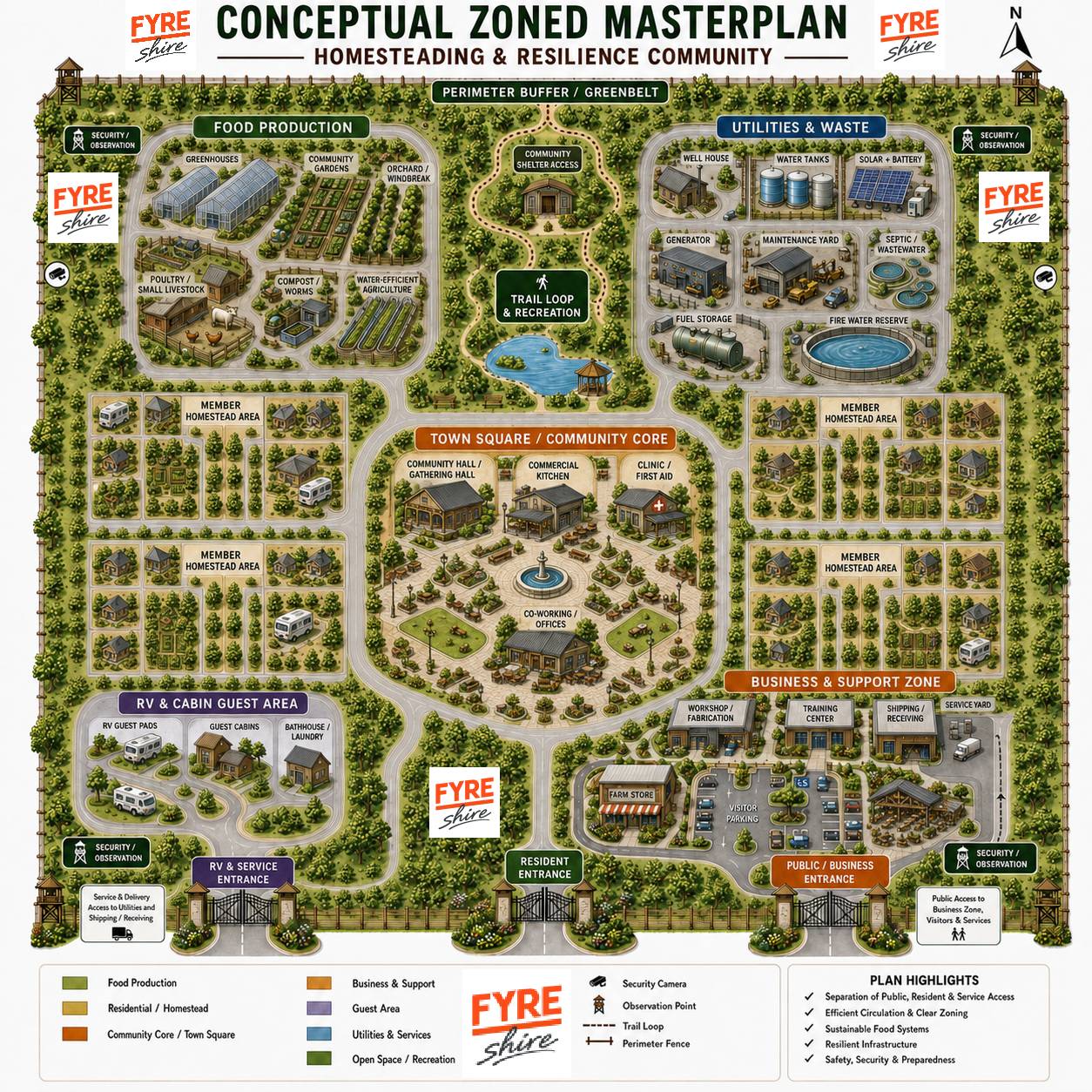
The community will be rural and designed for long term resilience. The proposed concept is organized into distinct zones based on each zones purpose and related activities. Public-facing uses would stay near controlled entrances and away from resident areas. Residents would have a dedicated entrance that is separate from the public-facing areas. Food production, utilities and waste, and support activities would also be located away from resident areas where they can function safely and efficiently without disturbing residents or guests.
Resident Homestead Zones – MEMBERS ONLY
Resident Homestead Zone areas are intended to be dedicated family spaces and could take various forms. There would be multiple homestead zones arranged around the Town Square at full buildout a variety of homestead types that would be grouped together with similar types of structures within each homestead zone. For example, some homestead zones could be RVs on pads while other homestead zones would be small homes, medium-sized homes, and maybe some larger homes. Each homestead zone would offer residents the ability to add their own gardens, sheds, and other features.
Town Square Zone – MEMBERS ONLY
The town square is the social and operational heart of the community. It would be a core element of the community with a Great Hall as a flexible use space for gatherings, events, church services, training, and other group activities. Within the Great Hall or maybe in other buildings could be areas for administration offices, a clinic or first-aid station, homeschooling classrooms, or other uses. The outdoor area around the Town Square would be a family commons area with shared outdoor plaza, probably with a fountain or similar such decoration.
Community Shelter – MEMBERS ONLY
While not an actual zone, it is worth noting that there would be access to a Community Shelter to provide residents with a safe, secure place to go in place of severe storms, high winds, tornados, or other emergency situations where seeking shelter is necessary. Shelter planning would be professionally engineered and integrated into the emergency governance plan. There could be more than one shelter depending on the final overall size and layout of the community.
Food Production Zone – AUTHORIZED PERSONNEL ONLY
The food production zone may include greenhouses, community gardens, orchards and windbreak plantings, poultry and livestock, worm systems, seed starting, and related activities.
Utilities, Waste, and Composting – AUTHORIZED PERSONNEL ONLY
Utilities should be planned as a service campus with a well house, water storage tanks, septic/wastewater treatment, composting, solid waste shredding/compaction, bulk solid waste disposal in dumpsters, and fire-water reserve. Some aspects may be distributed
Support Zone – AUTHORIZED PERSONNEL ONLY
The Support Zone would include a warehouse and equipment yard to support community activites. This zone is intended for shipping/receiving and warehousing of the community’s goods and materials, fuel storage, equipment storage, equipment maintenance, and vehicle maintenance.
Recreation Zones – MEMBERS AND RV PARK GUESTS ONLY
Recreation Zones are intended to provide recreation options for members and their guests, residents and their guests, and RV Park guests. There would likely be a mix of access so that RV Park guests would not necessarily have full access to all of the recreation areas within the community. Some of the potential recreational amenities could include a pool and water park area, an adults only pool, hot tub, maybe a lazy river, skeet/trap shooting, 100 yard shooting range, horse back riding, hay rides/wagon rides, a lake and fishing, paddleboats, canoes, or kayaking, and multiple separate trails throughout the property with some for walking, some for bike riding, and some for quads or ATVs, sports fields, paintball fields, and more. There could be certain recreational activities that make more sense to locate near the RV Park Zone or the Enterprise Zone, but that will require further further evaluation. THE FINAL LIST OF RECREATIONAL ACTIVITIES HAS YET TO BE DETERMINED.
RV Park Zone – RV PARK GUESTS ONLY
The RV Park Zone would be separate from all of the other zones except for potentially the Recreation Zone. It would probably provide RV pads with fire rings, cabins, a bathhouse, and laundry facilities.
Enterprise Zone – OPEN TO THE PUBLIC
The Enterprise business is intended to create income, jobs, and potentially provide services to residents. Members with an an entrepreneurial spirit would be able to lease space within this zone for a wide variety of business endeavors. Members would have priority in leasing space within the zone over non-residents. This zone would be a public-facing area for commerce benefitting the residents and neighbors. The uses may include a country store or farm store and other retail shops, coffee shop/restaurant, workshop/fabrication spaces, manufacturing activities, co-working spaces, offices, visitor parking. There is a strong likelihood of including an open, but covered marketplace for use as a farmer’s market or flea market/yard sale, concert venue, or other uses during different parts of the year.
Current Conceptual Zoned Masterplan
View the conceptual diagram to the right. You can click for a full screen view in a new window.
Be advised that the diagram above is a working concept, not a final engineering plan. It is intended to help prospective members and working groups discuss circulation, privacy, business activity, member and guest access, food production, utility placement, and town-square design. There is much more work to be done before we will have the final masterplan. It will change and evolve and improve over time until we get close to construction.
Note that the diagram is not to scale either. For example, the food production zone will consume a higher percentage of the land area than other zones.
Property legal model
The exact legal model we will use has not yet been determined yet. We have decades of experience with residential and commercial real estate and some experience with municipal airport hangar leasing and development. The early indicators are that the municipal airport development model utilizing long term 30-50 year leases (either turn-key design-build or maybe ground leases) are worth further exploration. The long term multi-decade leasing approach is a commonly used for stability, flexibility, and ease of financing. This may be the best model for this project, but this has yet to be determined and requires further evaluation of Texas law.
Potential locations
We are evaluating high plains locations in the panhandle of Texas with elevation, practical access, water feasibility, and long-term community viability in mind.
Primary counties under consideration
Initial county candidates may include Oldham, Deaf Smith, Hartley, Dallam, Parmer, and selected areas of Castro County, subject to parcel-level verification.
Site selection criteria
Potential sites will be evaluated for elevation, access, road frontage, privacy, drainage, well potential, groundwater district rules, septic/wastewater feasibility, soil conditions, wind exposure, wildfire risk, neighboring uses, utility options, county subdivision requirements, emergency-service access, and long-term expandability.
Important disclosure
No county or parcel should be assumed to be selected until due diligence is complete. County-level suitability does not guarantee a specific parcel is usable.
Feedback requested
We are looking for constructive input from people that are interested in our concepts, could possibly see themselves living in such a community, and people with experience in rural development, water systems, septic/wastewater, farming, off-grid power, construction, site planning, emergency management, hospitality, community governance, and other relevant skillsets, experience, and knowledge. All constructive criticism and feedback is appreciated.